Inclusive Equality: A Vision for Social Justice by Sally Witcher
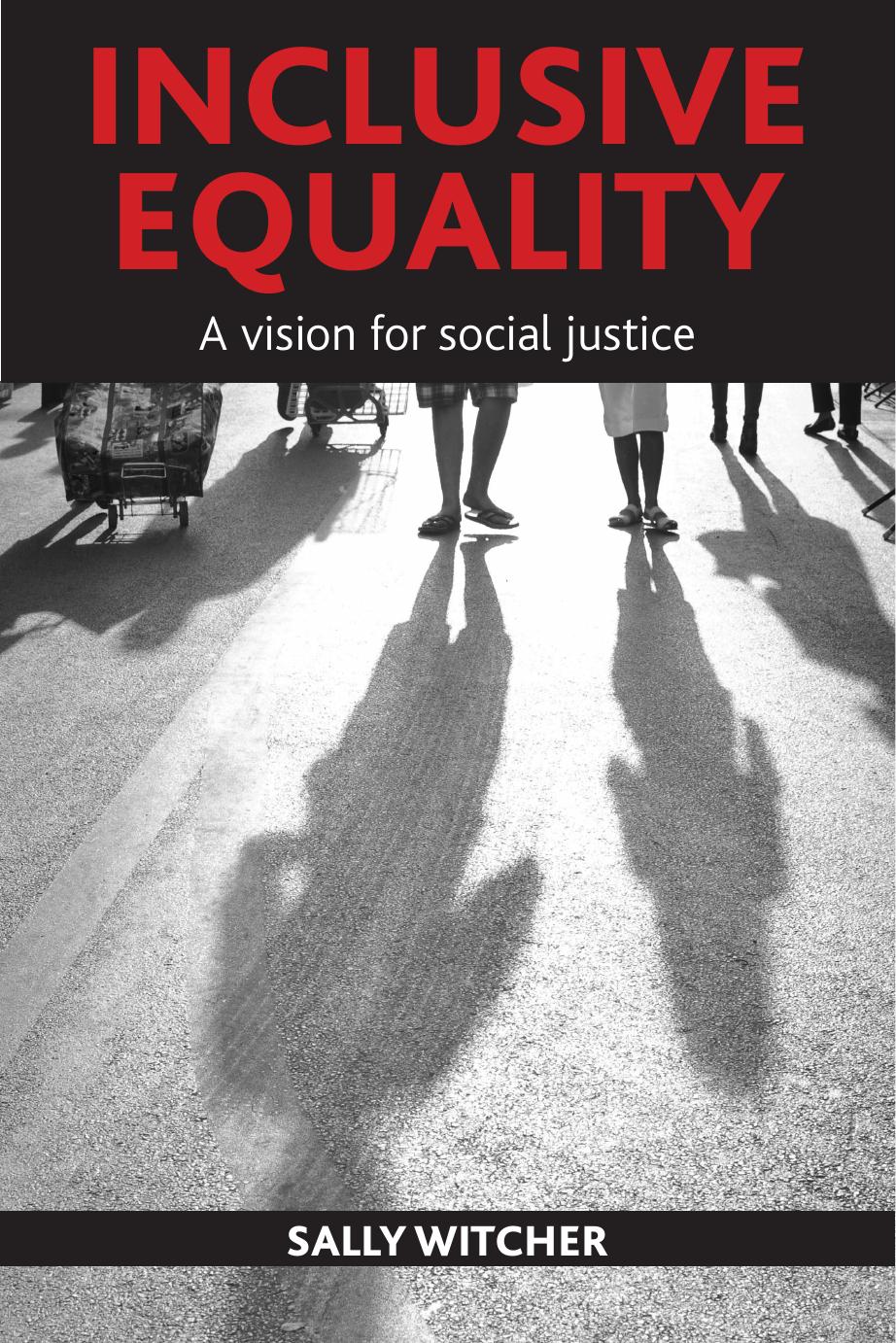
Author:Sally Witcher [Witcher, Sally]
Language: eng
Format: epub, pdf
ISBN: 9781447300045
Goodreads: 20948565
Publisher: Policy Press
Published: 2014-12-01T00:00:00+00:00
Understanding our own identity
So far, discussion has explored how identity is recognised from an external perspective. At its core, identity concerns how we understand and feel about ourselves. While this will obviously be affected by the quality of relationships â whether experienced as empowering or disempowering, humiliating or ego-boosting â we may need a reasonable level of self-esteem to interact socially in the first place. Discussion in Chapter Three began to indicate that whether or not we choose to interact (where we have a choice) critically depends on our expectations of how it will make us feel; whether we are confident that we know what to do and can do what it takes to engage successfully.
Once again, there are questions concerning where notions of appropriate behaviours come from. Are they biologically or genetically driven? Or do they result from internalising cultural messages about expectations of people with a particular make up?
There are a variety of theories from the field of psychology that assorted authors draw upon to answer such questions. The socialisation process through which people take on gendered qualities and characteristics can be conceptualised as moving towards environmental factors as an explanation (see Wharton, 2005). Theories of social learning tend to view people (particularly children) as lumps of clay, moulded by their environment and the reinforcements received for gender-appropriate or -inappropriate behaviours. In contrast, cognitive approaches are more concerned with the internal motivations of children to understand themselves, and how gender meanings are internalised and used to construct identity. Identification theorists argue that unconscious psychological processes account for at least some aspects of gender. For example, to summarise crudely, in societies where women are typically the primary carers, it is with them that both male and female children form their primary initial attachment (Chodorow 1978). However, their sense of gendered self is informed by identification with a same-sex parent or adult, bringing different implications for each; the maintenance of that initial connection predisposing female children to comfort with empathetic connection, while the identification of male children with more distant adult male figures not only reinforces separateness, but can prompt a need to âproveâ masculinity (Chodorow 1978, discussed in Wharton 2003).
In a similar vein, Llewelyn and Hogan (2000) discuss the use of systems analysis â âprocessâpersonâcontextâ â in studying children with physical disabilities. They explore âthe dynamics that can drive and accelerate the course of development by examining the synergistic influence of the characteristics of the person and of the environment that produces the behaviourâ (2000, p 160). Very much like theories of social learning described by Wharton, they discuss how a negative response from others can provoke negative self-belief, and avoidance. Their focus on process is potentially a third element to add to the mix of biological and social factors as contributors to the formation of identity.
The biopsychosocial (BPS) model is a further approach incorporating a psychological component. This has been used to explain the nature of incapacity for work and in steering approaches to rehabilitation. Broadly, it aims
Download
Inclusive Equality: A Vision for Social Justice by Sally Witcher.pdf
This site does not store any files on its server. We only index and link to content provided by other sites. Please contact the content providers to delete copyright contents if any and email us, we'll remove relevant links or contents immediately.
| Anthropology | Archaeology |
| Philosophy | Politics & Government |
| Social Sciences | Sociology |
| Women's Studies |
The Secret History by Donna Tartt(19088)
The Social Justice Warrior Handbook by Lisa De Pasquale(12190)
Thirteen Reasons Why by Jay Asher(8909)
This Is How You Lose Her by Junot Diaz(6886)
Weapons of Math Destruction by Cathy O'Neil(6279)
Zero to One by Peter Thiel(5801)
Beartown by Fredrik Backman(5754)
The Myth of the Strong Leader by Archie Brown(5507)
The Fire Next Time by James Baldwin(5444)
How Democracies Die by Steven Levitsky & Daniel Ziblatt(5218)
Promise Me, Dad by Joe Biden(5153)
Stone's Rules by Roger Stone(5087)
A Higher Loyalty: Truth, Lies, and Leadership by James Comey(4962)
100 Deadly Skills by Clint Emerson(4925)
Rise and Kill First by Ronen Bergman(4788)
Secrecy World by Jake Bernstein(4753)
The David Icke Guide to the Global Conspiracy (and how to end it) by David Icke(4717)
The Farm by Tom Rob Smith(4507)
The Doomsday Machine by Daniel Ellsberg(4490)
